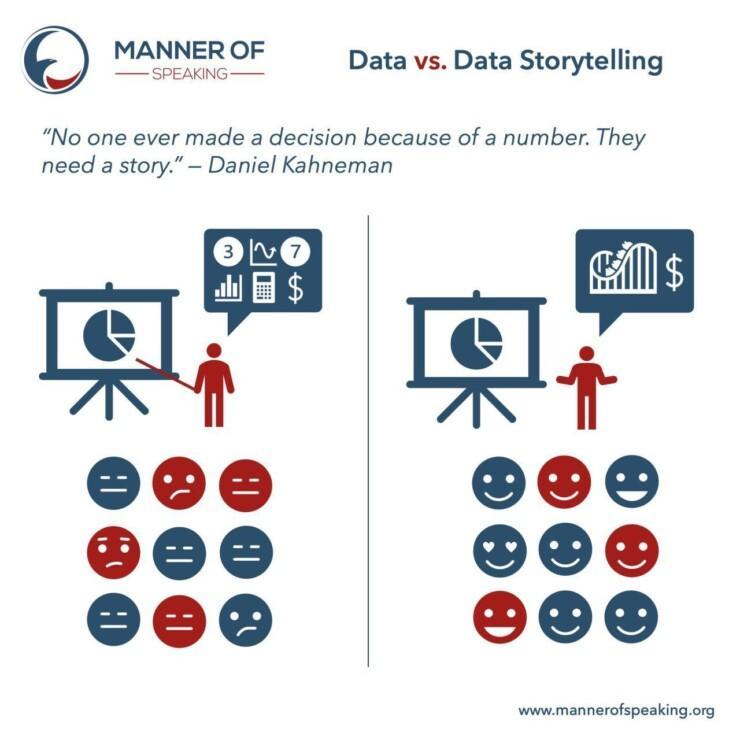
Do you remember, at some point in your life, being bored out of your mind watching a numbers-filled presentation without any interest whatsoever? You were suppressing your yawns, tried to focus, looked for any idea on what you should even think about these figures. You checked your watch every other minute hoping for the talk to end.
Of course, numbers can also be interesting, sometimes an experience all on their own. However, to awaken our interest, numbers have to first relate to something meaningful. We must understand what they’re all about and get interested in what these numbers are telling us.
Speaker and speech coach John Zimmer has summed it up like this:
There’s a giraffe outside
Zimmer guides us to think about meaning with an example about a giraffe. Let’s say that you open the door and see a giraffe outside. Your first question is unlikely to be:
- How long is the giraffe’s neck?
- How many spots does the giraffe have?
- How long does it take the giraffe to swallow?
Instead, your first question is more likely to be:
- What’s the giraffe doing here?
- How did it get here?
- Is the giraffe dangerous?
Zimmer uses this example to emphasise that we should try to tell people what the point is before we start listing details. You get the same conclusion by following Simon Sinek’s Start with why process (book / TED talk). Usually, we’re always first interested in why (what’s the point of this) and only then in what the issue specifically is.
What does it mean?
We can look for the meaning with a simple question: “What does it mean?” You might have to ask the same question multiple times – or with a slightly different phrasing – to find the deeper meaning. A bit like you might have to ask why repeatedly to get at the root of things.
- Our sales increased by 14 %.
- What does it mean? What’s going to happen? What caused it? What of it?
- 59 % of our company has started using AI in their work.
- What does it mean? Is it a lot or a little? Are we happy or worried about this? What use is this information?
- NPS is 37.
- What does it mean? Why is it 37? Has it been more or less previously? What’s been done to get this result or what are we planning to do with it? Why do we even measure NPS?
- 67 of the webinar participants were current clients and 21 were potential clients.
- What does it mean? Did we want the figures to be like this or not? What are the consequences of this? Why is this important information?
Another way to test this is to ask: “So what?” It might come off as a bit passive-aggressive when said out loud, but for personal use, it’s an excellent tool. If I can’t answer the question ”so what?” myself, I probably can’t tell this thing to an audience in a way that’ll interest them.
Who are you telling if not your audience?
A skilled communicator doesn’t just think about what something means. They think about what it means to this particular audience. After all, there is some reason why I’m telling this audience this, my speech probably has some goal. To achieve that goal, it’s necessary to put yourself in your audience’s position.
We barely ever get the audience on our side by pushing out facts and numbers and by shouting our own point of view. Every one of us has tried to stay awake during speeches like that. Instead, we get the audience interested in our message by telling them about what our message means to them specifically.
As Timi Wahalahti put it in a conversation I participated in:
”I don’t feel that there are many boring or meaningless numbers. But there are many, many examples of doing a bad job explaining and clarifying the meaning and context behind them.”
Thank you to other participants of that conversation as well! 🙏
PS. If speaking and presenting are interesting subjects to you, I recommend following John Zimmer on LinkedIn. You can also download his 50 public speaking tips (pdf).
TL;DR Share the meaning, not just numbers
- Simple numbers and facts don’t awaken interest if the listener doesn’t understand what’s the point and why it matters.
- Communication works better when the context and meaning are given before the details.
- ”What does it mean?” is the most important question for a communicator.
- You need to consider the meaning from the audience’s point of view.