Designing a presentation without the audience in mind is like writing a love letter and addressing it:
“TO WHOM IT MAY CONCERN”
– Ken Haemer
Haemer’s quote was one of my takeaways from a workshop given by John Zimmer, a nine-time European champion of public speaking (Toastmasters) and a TEDx speaker. The quote is important and ingenious, but also a bit contradictory. It’s contradictory in the sense that we can never know our audience the same way we’d know someone we’d write a love letter to.
However, that mustn’t stop us from trying to put ourselves in our audience’s position. Sometimes we know more about our audience, sometimes less. Regardless of how much we know, we should try to find out what’s important to them. That’s because, as Zimmer has also said, if we don’t know what our audience is interested in, we have a problem.
Speaker – subject – audience
In his workshop, Zimmer shared a tool that you can use when preparing to speak to an audience. The same tool is also useful for any situation where you’re communicating to influence people. For example, when you’re writing a presentation, are on your way to meet a client or are getting ready to suggest something new.
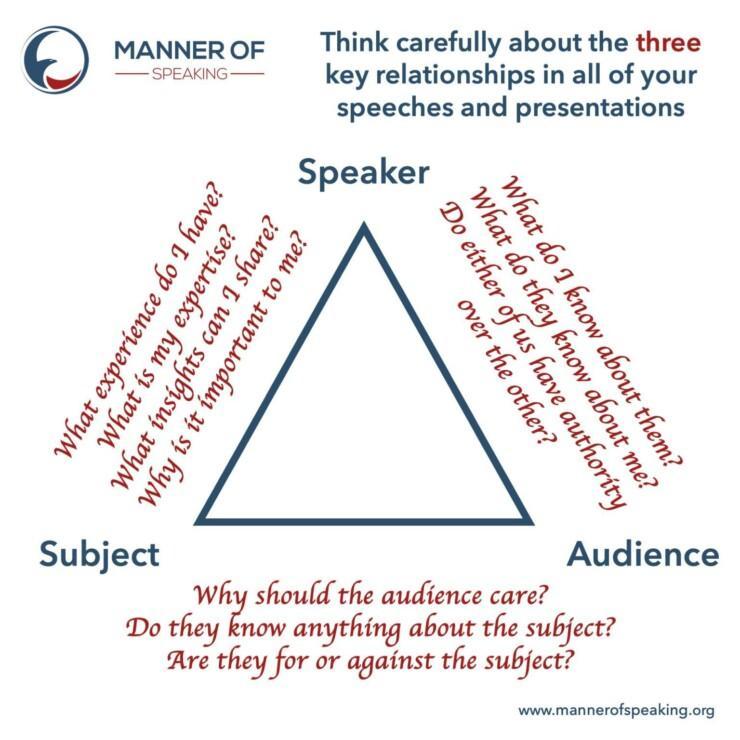
First, draw a triangle, and write the words speaker, subject and audience in the corners. Then consider the relationships between these corners.
Speaker – subject
What’s the relationship between the speaker and the subject? Why am I, specifically, talking about this subject? What do I know about this? Which specific point of view am I providing?
Often, we focus a lot on whether I really know the most about this subject, whether my reasoning is flawless or am I otherwise capable enough to talk about the subject. Especially people suffering from impostor syndrome can get too stuck on whether I have the right to talk about this subject.
Besides our knowledge of the subject, however, another important consideration is why the subject is important to me and why do I want to talk about it. Is there something personal about it that makes the subject interesting? Perhaps I can talk about the subject in an interesting way or perhaps I have some point of view that would interest the audience.
Speaker – audience
What’s the speaker’s relationship to the audience? What do I know about the audience, what does the audience know about me? Why am I, specifically, talking to this specific audience?
In the relationship between speaker and audience, we also easily get stuck considering whether I’m the right person to talk to this audience. Of course, it’s sometimes true that the message would be better received when shared by someone else, and that’s why this consideration is necessary. However, we forget that the audience doesn’t only consider the speaker from the point of view of whether the speaker is an authority or the supreme expert on the subject (logos).
The audience also considers whether the speaker is a good person and whether they care about the audience (ethos). The audience is also interested in how well the speaker presents their subject (pathos). If the speaker understands and wants to serve their audience, that’s already a big help in winning the audience to their side. Knowledge is of course important, but it’s not always enough on its own.
Audience – subject
What’s the audience’s relationship to the subject? What does the audience think about it, what’s the audience’s opinion? Is the audience interested in the subject and why should they maybe be?
This is the most important side of the triangle, in my opinion. Perhaps that’s why it’s the base of the triangle. The relationship between the audience and the subject defines how we should talk about things. If the audience is feeling positive, we can focus on creating hype, working towards a movement forwards or strengthening something that already exist. If the audience is negative towards the subject, our task is to entice and bend the audience to our side, to convince and to influence.
If we can’t say why the audience should care about the subject, the bottom falls out from under our whole speech. The audience won’t care a single bit about what we have to say if they don’t get the feeling that this is important to them. If someone doesn’t care, they usually stop listening. That’s why we can’t talk “to whom it may concern”, and we have to learn to talk to the audience on their terms instead.
At the centre of the triangle is the situation
Zimmer’s triangle examines the relationships between the speaker, the subject and the audience. Considering these relationships helps us keep the audience in mind when we’re getting ready to present our point convincingly. However, there is one more thing to consider, and that’s the situation.
What is the nature of the situation? How are people feeling? What’s happening before and after our speech? How much time is there and what sort of room will I be presenting in?
If you bring a number-filled PowerPoint presentation to kick off a summer party, you’re unlikely to get a particularly enthusiastic response. If you start doing stand-up at the meeting with the executives, you’re likely to fail just as badly. The same audience can react to the same subject and presentation style very differently depending on where we are and when.
We should think about why we’re talking, what we’re talking about, who we’re talking to and what kind of situation we’re talking in. Even a short moment to consider these points improves our communication and makes our success significantly more likely.
PS. If speaking and presenting are interesting subjects to you, I recommend following John Zimmer on LinkedIn. You can also download his 50 public speaking tips (pdf).
TL;DR There is no speech without the audience
- The audience is at the centre of communication. A presentation without acknowledging the audience is like a love letter without a recipient.
- Effective communication is built from the relationships between the speaker, the subject and the audience.
- Why am I, specifically, talking about this subject?
- Why am I, specifically, talking to this specific audience?
- Why should this subject interest this specific audience? (This is the most important of the three.)
- You also need to account for the situation you speak in.
- Even a short consideration of these points improves our communication.